I am an Assistant Professor in the Department of Computer Science at the Vrije Universiteit Amsterdam, where I am part of the AI & Behaviour group. I am also affiliated as an Honorary Lecturer with the Department of Computer Science at the University of Exeter in the UK. Before this, I was a postdoctoral researcher in the Computational Social Science department at the GESIS–Leibniz Institute for the Social Sciences in Germany.

My research spans computational social science, complex systems, network science, and data science. I explore how regularities and social phenomena emerge in different contexts, such as cities and social environments.

I am particularly interested in addressing urgent societal challenges such as urban crime, social inequalities, and human mobility. These challenges often involve complex, interrelated factors, requiring a complex-systems approach to understand and tackle them effectively.

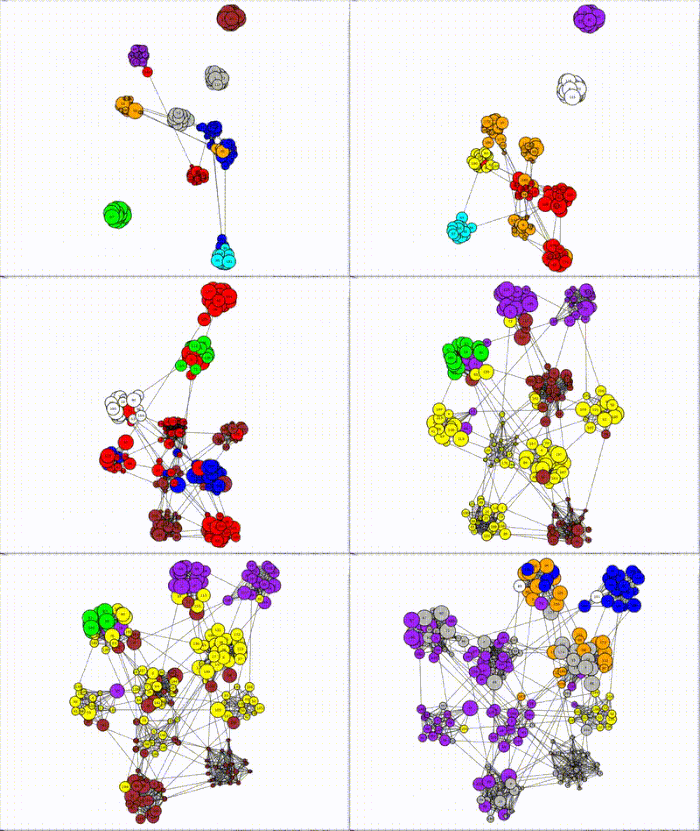
I study human dynamics, such as face-to-face interaction and web browsing behavior, to develop tools and models that address pressing issues like social biases and online privacy, with a focus on human-centered approaches. In another line of research, I also investigate how to explain the behavior of computational swarm intelligence to make swarm-based algorithms more transparent.
News

Research

City science and crime dynamics

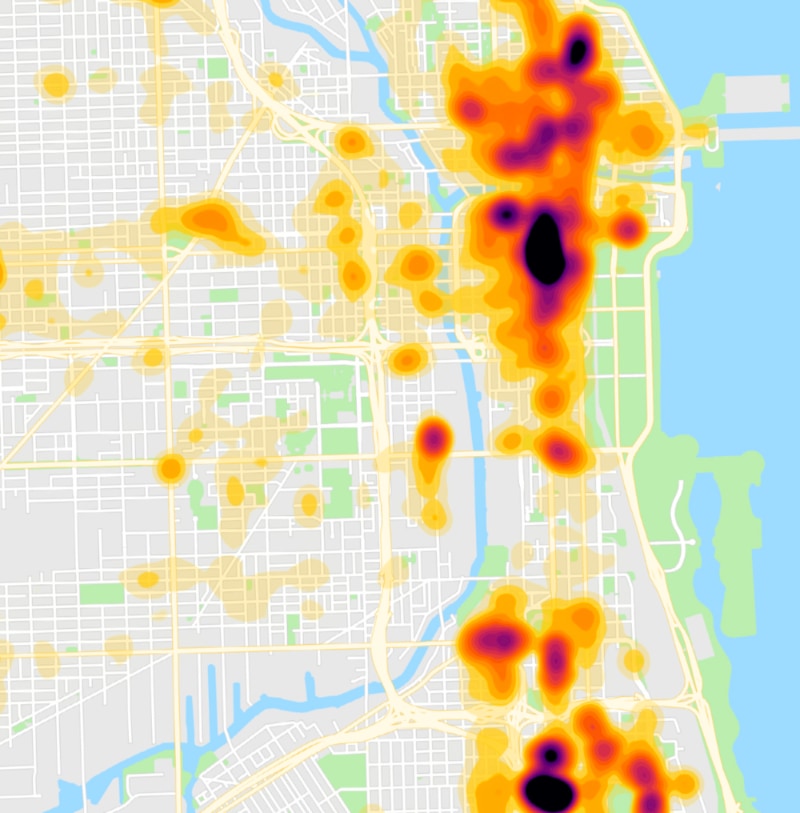
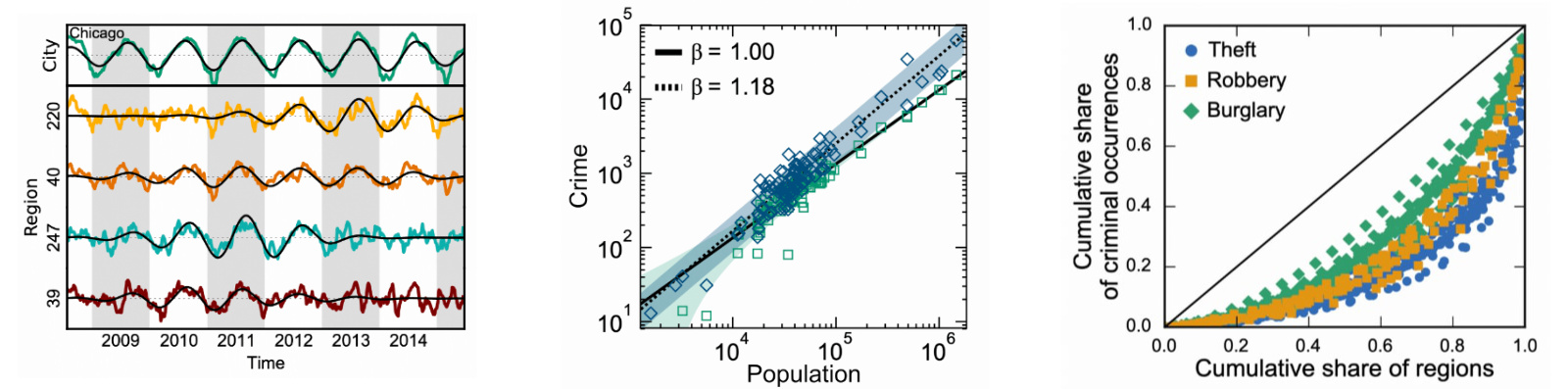
Cities bring people together to interact; they can be seen as evolving systems that exhibit a global order built from local-level decisions. Though such local-level processes seem disordered, cities display striking regularities. I am interested in uncovering these regularities and building tools and models to understand urbanization better — in particular, how crime exhibits regularities in its dynamics, structure, and growth.
Human dynamics and network inequality

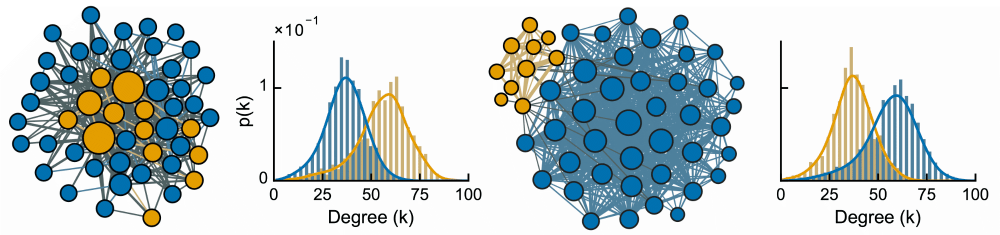
Though our daily behavior looks sophisticated and unpredictable, research has shown that simple mechanisms can explain parts of our behavior dynamics (e.g., face-to-face interaction, human mobility). I am particularly interested in understanding how these mechanisms drive systemic biases into people's lives, exploring how group interaction can produce social inequalities and how regularities in our behavior make us predictable online and offline.
Computational intelligence

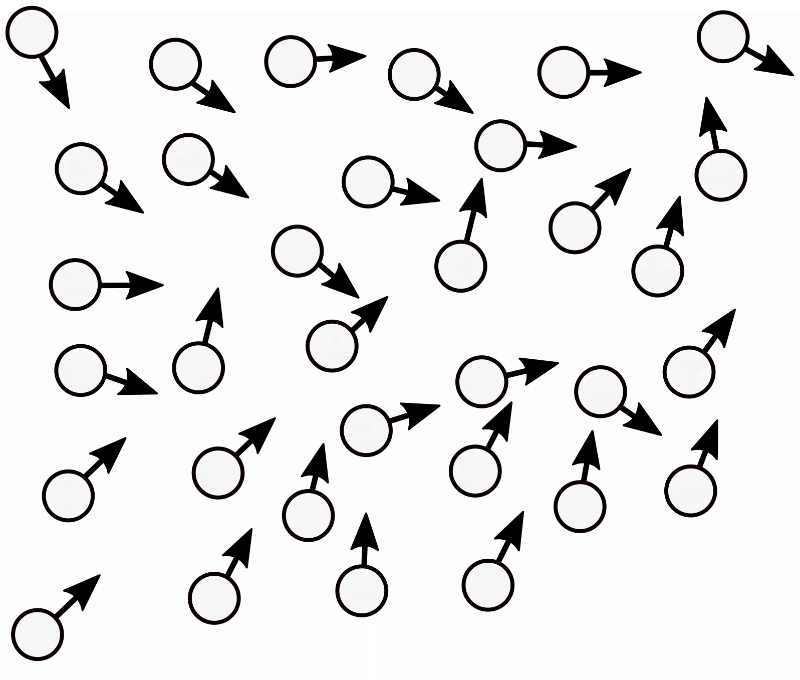
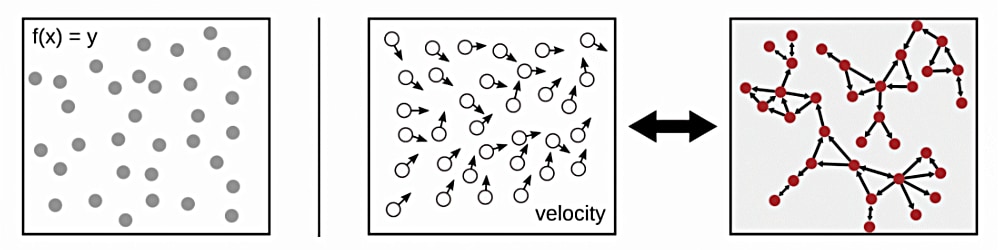
Swarm intelligence refers to the global order that emerges from simple social individuals interacting among themselves. In the past three decades, it has inspired many algorithmic models exhibiting distinct natural social behaviors, such as ant colonies and bird flocks. I investigate how to disentangle the complex behavior of computational swarms and make these algorithms more transparent.
Publications

Preprint

Systematic comparison of gender inequality in scientific rankings across disciplines[arXiv][PDF]
Ana Maria Jaramillo, Mariana Macedo, Marcos Oliveira, Fariba Karimi, and Ronaldo Menezes · arXiv (2025).
Stronger together? The homophily trap in networks[arXiv][PDF]
Marcos Oliveira, Leonie Neuhauser, Fariba Karimi · arXiv (2024).

Journal

Network analysis of cultural funding in Brazil: uncovering regional differences and signatures[DOI][PDF]
Diogo Pacheco, Gustavo Moraes, Diego Pinheiro, Josemar Faustino, Marcos Oliveira, Henilton Menezes, and Ronaldo Menezes · Applied Network Science 11, 43 (2026).
Larger cities, more commuters, more crime? The role of inter-city commuting in the scaling of urban crime[DOI][arXiv][PDF]
Simon Puttock, Umberto Barros, Diego Pinheiro, Marcos Oliveira · Crime Science 14, 19 (2025).
Browsing behavior exposes identities on the Web[DOI][arXiv][PDF]
Marcos Oliveira, Junran Yang, Daniel Griffiths, Denis Bonnay, and Juhi Kulshrestha · Scientific Reports 15 (2025).
Dynamic predictability and activity-location contexts in human mobility[DOI][arXiv][PDF]
Bibandhan Poudyal, Diogo Pacheco, Marcos Oliveira, Zexun Chen, Hugo S Barbosa, Ronaldo Menezes, and Gourab Ghoshal · Royal Society Open Science 11, 9 (2024).
Unravelling the dynamics of child sexual exploitation material circulation on the Dark Web[DOI][PDF]
Pramod Divakarmurthy, Bruno Requião da Cunha, Jean Fernando Passold, Marcos Oliveira, and Ronaldo Menezes · PLOS ONE 19, 7 (2024).
On the inadequacy of nominal assortativity for assessing homophily in networks[DOI][arXiv][PDF]
Fariba Karimi and Marcos Oliveira · Scientific Reports 13 (2023).
Combining sensors and surveys to study social contexts: Case of scientific conferences[DOI][arXiv][PDF]
Mathieu Génois, Maria Zens, Marcos Oliveira, Clemens Lechner, Johann Schaible, and Markus Strohmaier · Personality Science 4 (2023).
Group mixing drives inequality in face-to-face gatherings[DOI][arXiv][PDF]
Marcos Oliveira, Fariba Karimi, Maria Zens, Johann Schaible, Mathieu Génois, and Markus Strohmaier · Communications Physics 5, 127 (2022).
Beyond exploitation: Measuring the impact of local search in swarm-based memetic algorithms through the interactions of individuals in the population[DOI][PDF]
Clodomir Santana, Marcos Oliveira, Carmelo Bastos-Filho, and Ronaldo Menezes · Swarm and Evolutionary Computation 70, 101040 (2022).
Uncovering the social interaction network in swarm intelligence algorithms[DOI][arXiv][PDF]
Marcos Oliveira, Diego Pinheiro, Mariana Macedo, Carmelo Bastos-Filho, and Ronaldo Menezes · Applied Network Science 5:24 (2020)
Spatio-temporal variations in the urban rhythm: the travelling waves of crime[DOI][arXiv][PDF]
Marcos Oliveira, Eraldo Ribeiro, Carmelo Bastos-Filho, and Ronaldo Menezes · EPJ Data Science 7:29 (2018)
The scaling of crime concentration in cities[DOI][PDF]
Marcos Oliveira, Carmelo Bastos-Filho, and Ronaldo Menezes · PLOS ONE 12(8): e0183110 (2017)
Using Network Science to Assess Particle Swarm Optimizers[DOI][PDF]
Marcos Oliveira, Carmelo Bastos-Filho, and Ronaldo Menezes · Social Network Analysis and Mining 5:3 (2015)

Conference

The Hidden Rise of Toxicity: How Retweets Obscure Increasing Hostility in Brazilian Politics[DOI][PDF]
Soroush Karimi, Marcos Oliveira, and Diogo Pacheco · Proceedings of the 18th ACM Web Science Conference 2026 (WebSci ’26), pp. 211–220.
Modelling Misinformation Spread: The Role of Network Density in Diverse Social Structures[DOI][arXiv][PDF]
Soroush Karimi, Marcos Oliveira, and Diogo Pacheco · Advances in Social Simulation (ESSA 2021), pp. 223–230 (Springer, 2025).
Towards the identification of money laundering in bank transactions using Recurrent Neural Networks[DOI][PDF]
Isadora Xavier, Edvaldo Veiga, Andrea Maria NC Ribeiro, Rodrigo de Paula Monteiro, Marcos Oliveira, Rodrigo Amaro, and Diego Pinheiro · 2024 IEEE Latin American Conference on Computational Intelligence (LA-CCI), Bogota., Colombia. 2024.
Regularizing Neural Networks with Noise Injection for Classification of Brain Tumor in Magnetic Resonance Imaging[DOI][PDF]
Umberto Barros-Filho, Paulo Rocha, Marcos Oliveira, Andrea Ribeiro, Rodrigo Monteiro, and Diego Pinheiro · IEEE Latin American Conference on Computational Intelligence (LA-CCI), Recife, Brazil. 2023.
Using Vector Fields in the Modelling of Movements as Flows: A Case Study with Cattle Trade Networks[DOI][PDF]
Sima Farokhnejad, Marcos Oliveira, Eraldo Ribeiro, Ronaldo Menezes · International Conference on Complex Networks (CompleNet), Aveiro, Portugal. 2023
Getting the Boot? Predicting the Dismissal of Managers in Football[DOI][PDF]
Mounir Attié, Diogo Pacheco, Marcos Oliveira · International Conference on Complex Networks (CompleNet), Aveiro, Portugal. 2023
Web Routineness and Limits of Predictability: Investigating Demographic and Behavioral Differences Using Web Tracking Data[DOI][arXiv][PDF]
Juhi Kulshrestha, Marcos Oliveira, Orkut Karacalik, Denis Bonnay, and Claudia Wagner · Proceedings of the International AAAI Conference on Web and Social Media (ICWSM), 2021.
Characterizing the Social Interactions in the Artificial Bee Colony Algorithm[DOI][arXiv][PDF]
Lydia Taw, Nishant Gurrapadi, Mariana Macedo, Marcos Oliveira, Diego Pinheiro, Carmelo Bastos-Filho, and Ronaldo Menezes · IEEE Congress on Evolutionary Computation (IEEE CEC). 2019.
The Influence of the Circadian and Ultradian Rhythms to Human Mobility: Empirical Evidences from Location-Based Check-Ins
Hugo Barbosa, Marcos Oliveira, Diogo Pacheco, Gourab Ghoshal, and Ronaldo Menezes · NERCCS 2018: First Northeast Regional Conference on Complex Systems, Binghamton, NY, USA. 2018.
Better Exploration–Exploitation Pace, Better Swarm: Examining the Social Interactions[DOI][PDF]
Marcos Oliveira, Diego Pinheiro, Mariana Macedo, Carmelo Bastos-Filho, and Ronaldo Menezes · 4th IEEE Latin American Conference on Computational Intelligence (LA-CCI), Arequipa, Peru. 2017.
Tippers and stiffers: An analysis of tipping behavior in taxi trips[DOI][PDF]
David Elliott, Marcello Tomasini, Marcos Oliveira, and Ronaldo Menezes · IEEE Ubiquitous Intelligence and Computing, San Francisco, California, USA. 2017.
Using Social Media to Assess Neighborhood Social Disorganization: a Case Study in the United Kingdom[DOI][PDF]
Diogo Pacheco, Marcos Oliveira, and Ronaldo Menezes · AI4BigData at the 30th International FLAIRS Conference, Marco Island, Florida, USA. 2017.
Communication Diversity in Particle Swarm Optimizers[DOI][PDF]
Marcos Oliveira, Diego Pinheiro, Bruno Andrade, Carmelo Bastos-Filho, and Ronaldo Menezes · ANTS 2016, Tenth International Conference on Swarm Intelligence, Brussels, Belgium. 2016.
From Criminal Spheres of Familiarity to Crime Networks[DOI][PDF]
Marcos Oliveira, Hugo Barbosa-Filho, Tobin Yehle, Sarah White, and Ronaldo Menezes · 6th Workshop on Complex Networks (COMPLENET), New York, USA. 2015.
Towards a Network-based Approach to Analyze Particle Swarm Optimizers[DOI][PDF]
Marcos Oliveira, Carmelo Bastos-Filho, and Ronaldo Menezes. · 2014 IEEE Symposium on Swarm Intelligence, Orlando, USA. 2014.
The Spatial Structure of Crime in Urban Environments[DOI][PDF]
Sarah White, Tobin Yehle, Hugo Serrano, Marcos Oliveira, and Ronaldo Menezes · 6th International Conference on Social Informatics (SocInfo 2014). First Workshop on Criminal Network Analysis and Mining, Barcelona, Spain. 2014.
Political Social Networks Reveal Strong Party Loyalty in Brazil and Weak Regionalism[PDF]
Marcos Oliveira, Carmelo Bastos-Filho, and Ronaldo Menezes · Sixth ASE International Conference on Social Computing, Stanford, USA. 2014.
Assessing Particle Swarm Optimizers Using Network Science Metrics[DOI][PDF]
Marcos Oliveira, Carmelo Bastos-Filho, and Ronaldo Menezes · 4th Workshop on Complex Networks (Complenet), Berlin, Germany. 2013.
Using Network Science to Define a Dynamic Communication Topology for Particle Swarm Optimizers[DOI][PDF]
Marcos Oliveira, Carmelo Bastos-Filho, and Ronaldo Menezes · 3rd Workshop on Complex Networks (Complenet), Melbourne, USA. 2012.
Optimizing a Routing Algorithm Based on Hopfield Neural Networks for Graphic Processing Units[DOI][PDF]
Carmelo Bastos-Filho, Marcos Oliveira, Denis Silva, Róbson Santana · IEEE Symposium on Foundations of Computational Intelligence (FOCI), Paris, France. 2011.
Uma Implementação em FPGA de Redes Neurais de Hopfield para Roteamento em Redes de Comunicação[DOI][PDF]
Marcos Oliveira and Carmelo Bastos-Filho · Anais do X Congresso Brasileiro de Inteligência Computacional, Fortaleza, Brazil. 2011
Car Setup Optimization Using Multi-Objective Swarm Algorithms[DOI][PDF]
Marcos Oliveira, Marcelo Lacerda, Érick Barbosa, Paulo Cordeiro, and Carmelo Bastos-Filho · Anais do X Congresso Brasileiro de Inteligência Computacional, Fortaleza, Brazil. 2011.
Impact of the Random Number generator quality on particle swarm optimization algorithm running on graphic processor units[DOI][PDF]
Carmelo Bastos-Filho, Marcos Oliveira, Débora Nascimento, and Alex Ramos · 10th International Conference on Hybrid Intelligent Systems, Atlanta, USA. 2010.

Book chapters

Minorities in networks and algorithms[DOI][arXiv][PDF]
Fariba Karimi, Marcos Oliveira, and Markus Strohmaier · Handbook of Computational Social Science, chapter 31, pp. 438–451 (Edward Elgar Publishing, 2025).
Sensing close-range proximity for studying face-to-face interaction [DOI][PDF]
Johann Schaible, Marcos Oliveira, Maria Zens, and Mathieu Génois · Handbook of Computational Social Science. Volume 1. Routledge, (2021)
Spatial concentration and temporal regularities in crime[arXiv][PDF]
Marcos Oliveira and Ronaldo Menezes · To appear in "Understanding Crime through Science" (Springer Computational Social Sciences series). 2019.
Analysis of the Performance of the Fish School Search Algorithm Running in Graphic Processing Units[DOI][PDF]
Anthony Lins, Carmelo Bastos-Filho, Débora Nascimento, Marcos Oliveira, and Fernando Lima-Neto · Theory and New Applications of Swarm Intelligence. 1ed.: InTech. 2012.
Running Particle Swarm Optimization on Graphic Processing Units[DOI][PDF]
Carmelo Bastos-Filho, Marcos Oliveira, and Débora Nascimento · Search Algorithms and Applications. 1ed.: InTech. 2011.

Datasets

A web tracking data set of online browsing behaviour of 2,148 users
Anonymized data set consisting of 2,148 users' web tracking data, including anonymized URL, domain and category of each visited page, plus self-reported gender and age.
Combining Sensors and Surveys to Study Social Interactions
Four data sets studying social behaviour at international scientific conferences, using RF-ID sensors to capture face-to-face proximity every 20 seconds.

Software

assortativity
Estimate assortativity in networks with groups of different sizes.
face_to_face_minority_dynamics
Code for modelling group mixing in face-to-face gatherings.
network_swarm
A network-based approach to analyze particle swarm optimizers.
pso_gpu
Running Particle Swarm Optimization on GPUs.
pso_dynamic_topology
A swarm with dynamic topology.
hnn_fpga
VHDL model for Hopfield Neural Networks (HNN) for routing in communication networks.
spatial_reference
Find the correct spatial reference (EPSG) for a set of points.
partitions2graph
From partitions of a graph to a whole graph.
graphml2metis
Converts a file from graphml to METIS format.
simulator
A simple tool for running experiments in parallel.

Links